Five regatta venues: Bruinisse, Weymouth, Carnac, Garda, Aabenraa
A championship is half racing and half place. The event notices spent as many words on mussels, standing stones and campsites as on course areas, and quite right too. Here are the five venues that carried most of the international programme in 2010 and 2011, in the order a boat on a road trailer might have met them.
Bruinisse, Netherlands
Events: RS500 Worlds 2010, RS100 and RS500 Euro Grand Prix in May 2011, RS Feva Worlds 2011, Dutch Skiff Regatta in September 2011.
Bruinisse is a small harbour town in Zeeland with a large marina, and in these two years it was the nearest thing the international classes had to a home. The host was the sailing school Aquavitesse, named in the RS100 notice, which also offered four-bed rooms at €15 a night.
The water is the Grevelingenmeer. It was an arm of the sea until the Delta Works dammed both ends in the 1960s and early 1970s, and it is now usually described as the largest salt-water lake in western Europe. There is no tide to speak of. For a race officer that is a gift: no stream across the course, no waiting for water.
What you get instead is chop. The practice race report from 2010 says it plainly: with the breeze at 22 to 25 knots the chop became the waves, and keeping the bow from burying was not entirely preventable. The Wednesday report that week calls it a lake and then corrects itself to an inland sea. On the gentle days it was lovely. Friday’s finale was sailed in sunshine and 9 to 12 knots.
Ashore, the Feva Worlds notice pointed families to a holiday park five minutes’ walk away, with a pool and bowling. A Nations Cup race was planned inside the harbour itself, on a very tight course, for the benefit of spectators. One practical detail: there was no cash machine in the marina. The same post pointed to the town of Zierikzee, 15 minutes away by car. And the local speciality is mussels, which the 2010 fleet ate the night before the deciding race.
Getting there from Britain usually meant a short ferry crossing and a drive up through Belgium. Rotterdam airport is about an hour away.
Carnac, France
Events: RS Feva and RS Tera Worlds 2010, RS500 Euro Grand Prix within the RS Eurocup, May 2011.
The Yacht Club de Carnac sits among long sandy beaches on the Baie de Quiberon in southern Brittany. The bay is sheltered from the Atlantic by the Quiberon peninsula, and it is thick with sailing: the French national sailing school is based a few miles away at Saint-Pierre-Quiberon.
The 2011 notice is the most confident piece of venue writing of the lot. It promises a reliable sea breeze, which is why racing was set for the afternoons with two races a day. It describes the bay’s normal state as perfect flat skiff water, with rolling waves on other days, and room for two enormous trapezoid courses with separate finish lines. The club had form with skiffs, having run the 18 foot skiff Europeans.
Afternoon racing has a side benefit that the notice does not hide. Mornings are free for the megalithic alignments, or for sleeping it off.
The 2010 junior worlds here, Feva and Tera together, are best remembered through the class’s end-of-year piece: 140 Fevas on the start line, fifty-odd Teras, and a daily prize that kept the dinghy park tidier than any before it. The drive is about two and a half hours from the ferry at Saint-Malo.
Lake Garda, Italy
Event: the first Garda Cup, Easter 2011, at Circolo Nautico Brenzone.
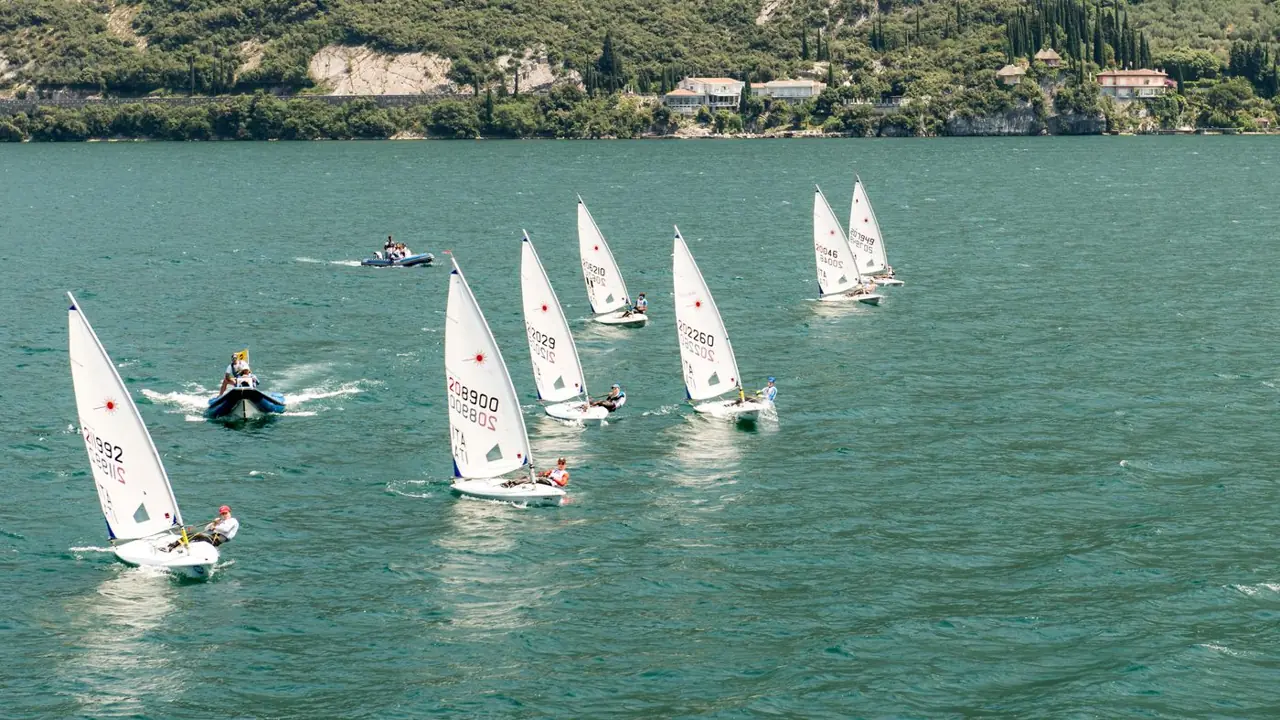
Garda needs little introduction to anyone who has seen a sailing magazine. The lake is long and narrow, with mountains on both sides at its northern end, and those mountains run the weather. On a settled day a northerly called the Peler blows down the lake from early morning. Around midday it fades and a southerly, the Ora, fills in for the afternoon. Two sailing breezes a day, more or less to order.
Brenzone is on the eastern shore, some way south of Malcesine and Torbole. The invitation went out in January for 24 and 25 April and promised charter boats and sun on your back.
The reports are short and happy. The organisers called it a massive success for the Feva, Tera and RS500, with the Fevas the biggest fleet. The RS500s came from Italy, the Netherlands and Sweden, and the Dutch winners announced that Easter on Garda was now a tradition.
The RS100s went to a different Italian lake that summer: Gravedona, at the top of Lake Como. The notice describes a club guest house with eight-bed dormitories at €15 a night.
Aabenraa, Denmark
Event: RS Tera Worlds, 1 to 5 August 2011.
Aabenraa lies at the head of a fjord in southern Jutland, not far above the German border. The fjord opens onto the south-western end of the Little Belt, and its inner waters have a reputation for staying calm. For a world championship of single-handed junior boats, some of them sailed by quite young children, that shelter is the point.
The class announcement called it one of Denmark’s best junior sailing locations. The notice has a homely feel. You could camp at the club, though facilities were limited and tents could be no bigger than three metres by four. Food after racing was included every day. The club ran a three-day training camp beforehand for €40.
It was also a long way from most of the fleet. The notice gives Hamburg as the nearest big airport at 160 km, with Copenhagen at 215 km. The organisers turned the distance into a selling point with a map linking the Feva Worlds, the Tera Worlds, the Swedish nationals and a camp on a Swedish island into a single northern tour.
Weymouth and Portland, England
Events: RS500 Worlds and RS100 UK Nationals, within the RS Games, August 2011.
The academy stands on the Portland side of Portland Harbour. In 2011 it was a year away from hosting the Olympic sailing, and the RS500 notice leans on that hard. Its sailing case is sound, though: good winds, a choice of water from sheltered to open sea, and a small tidal range. The notice calls it the lowest in the UK.
The choice of water is the thing. Portland Harbour is enclosed by breakwaters and sheltered. Weymouth Bay, outside, is far more open. The day one report has the fleet reaching 3.3 nautical miles out to a course in the bay, where the waves were far bigger than in the harbour and the wind was a gusting force five. Thursday and Friday were planned on a trapezoid course shared with the RS800s.
Then there is Portland Bill. The tidal race off the tip of the island is notorious, and somebody posted a video of it a month before the event. The accompanying note points out that it is at the far end.
The fleet could not arrive until 15:00 on the Sunday, because the Olympic test event had the site. As the secretary put it, the Olympians were clearing out for the more important matter of the RS500 Worlds.
Choosing between them
If you sail a boat that hates chop, Carnac and Aabenraa are your venues. If you want guaranteed breeze, Garda’s clockwork winds are hard to beat. Weymouth gives a race officer the most options, and Bruinisse is the easiest to reach from most of north-west Europe. In 2010 and 2011 the classes managed to use all five, which says something about how willing these sailors were to hitch up a trailer.
Questions readers ask
Is the water at Bruinisse tidal?
No. Bruinisse sits on the Grevelingenmeer, a salt-water lake closed off from the North Sea by dams in the early 1970s. The 2010 reports call it more of an inland sea, and it throws up a short, steep chop in a breeze.
Why did the classes go to Weymouth in 2011?
The Weymouth and Portland National Sailing Academy was about to host the 2012 Olympic sailing, and the RS Games ran there a year ahead, straight after the Olympic test event. The notice also praised its small tidal range.
When does the wind blow at Carnac and on Garda?
The Carnac notice scheduled racing for the afternoons to use the sea breeze in the Baie de Quiberon. On Lake Garda the usual pattern is a northerly, the Peler, in the morning and a southerly, the Ora, from around midday.