RS500
A narrow single-trapeze two-hander that taught a generation of crews to wire.
Drag to turn the boat; pinch, or click and then scroll, to zoom. A schematic model built from published dimensions, not a builder's drawing.
| Crew | 2 |
|---|---|
| Trapeze | Crew |
| Designer | Phil Morrison |
| Length | 4.34 m |
| Beam | 1.57 m |
| Hull weight | 87 kg |
| Mainsail | 9.3 m² |
| Jib | 3.4 m² |
| Spinnaker | 13.5 m² |
| Portsmouth number | 972 (2011) |
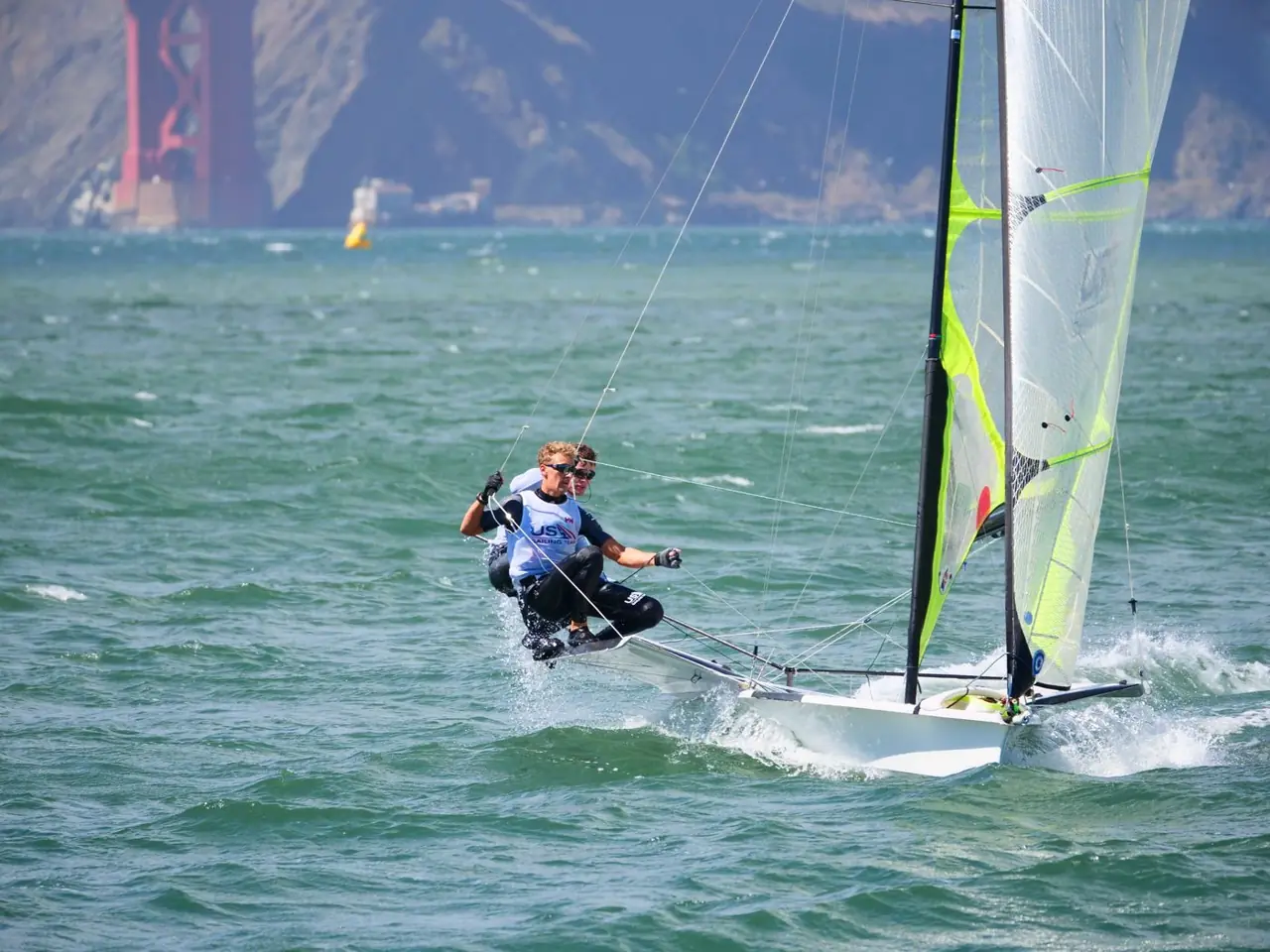
The RS500 is a two-person dinghy with one trapeze, an asymmetric spinnaker and a narrow, easily driven hull designed by Phil Morrison. It was pitched at the gap between junior boats and the twin-wire skiffs: fast enough to be exciting, simple enough that a pair coming out of a Feva or a Laser could cope. Of all the classes in this logbook, the RS500 gets the most ink, because in 2010 and 2011 it was holding its first World Championships and the people running the class were writing it all down.
Narrow, low and quick to climb back into
At 1.57 metres the RS500 is slim for a boat of 4.34 metres. That narrow beam is the reason for the trapeze: there is not enough width to hold the rig down by hiking alone, so the crew goes out on the wire and the helm sits on the side.
The cockpit is open and uncluttered, with a low transom. After a capsize, and there will be capsizes, you can slide back in over the stern instead of hauling yourself over a high side tank. Centreboard and rudder both pivot, which takes much of the drama out of launching from a beach or a shallow slipway.
Spars are aluminium alloy and the hull is GRP composite. Two rig sizes share the hull:
| S rig | XL rig | |
|---|---|---|
| Mainsail | about 7.4 m² | about 9.3 m² |
| Jib | about 2.9 m² | about 3.4 m² |
| Spinnaker | about 13.5 m² | about 13.5 m² |
The S rig keeps the boat manageable for younger and lighter pairs. Most adult racing is done with the XL.
On the wire
Upwind with the crew flat out and the helm hiking, the RS500 slices along with little fuss. It responds to small changes in trim and the crew, with a single jib sheet and a trapeze handle to manage, has time to look around and call the shifts.
Downwind is where it earns the word skiff. The spinnaker is large for the hull, and in a breeze the boat lifts and stays up. There is a vivid account of the 2010 Worlds practice race, sailed in 22 to 25 knots with gusts near 30, in which only half the fleet launched and the chop had “by now” become waves. Keeping the bow from burying was, the reporter noted, exciting and not entirely preventable.
It is a forgiving place to learn trapezing because the helm stays inboard and can keep the boat steady while the crew finds their feet.
Bruinisse 2010 and Weymouth 2011
The inaugural World Championship was held at Bruinisse in the Netherlands from 15 to 20 August 2010. The daily reports read like a two-boat duel. Britain’s Alex Taylor and Bryan Mobbs led after Wednesday’s racing, with Tim Wilkins and Heather Martin two points behind. On day four the pair were described as inseparable, match racing each other clear of the fleet. On the final morning, in sun and 9 to 12 knots, Wilkins and Martin kept a close cover on their rivals and took the title. Annika Ellerbrock and Anne Werner of Germany won the ladies’ title by three points, and Hansebas Meijer and Fedor Couvert of the Netherlands were the youth champions.
A year later the class went to Weymouth and Portland, the 2012 Olympic venue, for an event sponsored by Magic Marine that doubled as the UK Nationals. It had grown: the opening report counts 56 entries from 8 countries, roughly double the first year, and on day one 52 boats started in a fresh south-westerly. This time the result went the other way. Taylor and Mobbs won with a day in hand and stayed ashore for the final race.
Around those two regattas the class was organising itself. A Dutch class association was founded in Amsterdam in early 2011. A European Grand Prix circuit linked Bruinisse in May, Carnac at the end of May and the Weymouth Worlds. And six boats were shipped to Lake Victoria in Uganda to form what was described as the first RS500 fleet in Africa.
The tone of all this is worth noting. The international chairman of the time, Michiel Geerling, wrote on the class page that the RS500 bridged the gap between the Olympic professional classes and local fun classes, and that it was the best way to make “friends for life”. The reports are full of parties, and the racing was evidently taken seriously too.
Later history is shorter to tell. A EuroCup series began in 2017. World Championships continued until 2025, drawing sailors from 16 countries over the years, and in November 2025 the class’s World Sailing status was withdrawn.
Buying one now
A used RS500 is an inexpensive way to get a trapeze and an asymmetric. Before parting with money:
- Check which rig is included. Converting between S and XL means buying sails.
- Inspect the trapeze wires, rings and adjusters, and the mast fittings they hang from. Replace anything frayed without debate.
- Look at the gunwales where the crew’s feet go. Worn non-slip is easy to fix; cracking underneath is not.
- Press the cockpit floor and foredeck for soft spots.
- Run the spinnaker pole and chute on land and look at the sock and the halyard.
- Swing the centreboard and rudder through their full travel and look for play in the pivots.
- Sight up the mast and check the spreaders are secure and symmetrical.
Class racing depends on where you live. In 2010 and 2011 the strongest fleets were Dutch and British, with Italy, Sweden and others joining in.
How it compares
The hiking RS400 is the obvious alternative for adults: wider, heavier, no wire, and rated slightly faster on the handicap lists of the period. The RS500 suits lighter and younger crews better and teaches trapeze skills the 400 cannot. Pairs who master it and want both sailors on the wire move to the RS800. Coming the other way, it is the natural step up from the RS Feva, with the same kind of spinnaker system on a much quicker hull.
Questions readers ask
Who trapezes on an RS500?
The crew. The helm hikes. That makes it a common first trapeze boat, since only one person has to learn the wire at a time.
What are the S and XL rigs?
Two sail plans for the same hull. The XL has the larger mainsail and jib, about 9.3 and 3.4 square metres; the S is smaller at about 7.4 and 2.9. The spinnaker is the same size on both.
Who won the first RS500 World Championships?
Tim Wilkins and Heather Martin won the inaugural Worlds at Bruinisse in the Netherlands in August 2010. Alex Taylor and Bryan Mobbs, runners-up that year, won at Weymouth in 2011 with a day to spare.
Is the RS500 still a World Sailing class?
It held World Sailing class status from November 2009 until November 2025, when the status was withdrawn. World Championships were held from 2010 to 2025.
Where it sits in the fleet
- RS Tera 2.87 m
- RS Quba 3.53 m
- RS Feva 3.66 m
- RS200 3.96 m
- RS Vareo 4.25 m
- RS300 4.27 m
- RS100 4.32 m
- RS500 4.34 m
- RS600 4.47 m
- RS600FF 4.47 m
- RS400 4.52 m
- RS Vision 4.57 m
- RS700 4.70 m
- RS800 4.80 m
- RS Elite 7.40 m
Hull length and sail area drawn to one scale, from the published figures in each class file. The shapes are schematic; a boat shown as a bare hull has no separate mainsail figure on file.
RS500 in the logbook
RS-500 Worlds are officially opened!
RS-500 Worlds are officially opened! The RS-500 Worlds on the 2012 Olympic Venue of Weymouth are now officially opened. There’s no doubt that the RS500 will be…
Magic Marine RS500 worlds – day1
RS500's at Weymouth. Photo by fotoboat. Day one of the Magic Marine RS500 World Championship and Weymouth didn’t disappoint. As the wind built, so did the…
The Big Build up to Worlds is on!
You’ve read and maybe even heard the special soundtrack for the event. Well now the Olympians are clearing the site for the more important matter of the RS500…
Special “RS500-music” during the Worlds.
We are very proud to announce that Marcoen Verrest (studied Piano) and Marco Bakkenhoven, two young producers from Holland who produce music ranging from…
RS500 Worlds – a victim of success!!
We hear a rumour – unconfirmed as yet, that one of our star entrants may have to withdraw from the RS500 worlds due to her outstanding success elsewhere! Oddly…
RS Games – Runners and Riders – RS500 fleet
There’s no doubt that the RS500 will be a class in the spotlight at the RS Games, a multi-class extravaganza taking place at Weymouth and Portland National…