RS100
One sailor, no trapeze, and a spinnaker bigger than the mainsail.
Drag to turn the boat; pinch, or click and then scroll, to zoom. A schematic model built from published dimensions, not a builder's drawing.
| Crew | 1 |
|---|---|
| Trapeze | None |
| Designer | Paul Handley |
| Introduced | 2009 |
| Length | 4.32 m |
| Beam | 1.83 m |
| Hull weight | 52 kg |
| Mainsail | 10.2 m² |
| Spinnaker | 12.1 m² |
| Portsmouth number | 981 (10.2 rig), 1004 (8.4 rig), 2021 |
A single-hander with an asymmetric spinnaker is a hard thing to design well. One person has to steer, hike, trim the main and fly a kite, and there are only two hands available. The RS100, designed by Paul Handley and launched in 2009, was RS Sailing’s answer, and the development was unusually public: a blog followed the prototypes through testing. The finished boat is a 4.3 metre epoxy foam-sandwich hull with a two-piece carbon mast, no trapeze, no racks and a spinnaker of roughly 12 square metres.
It arrived just ahead of the two seasons this logbook follows, and a good share of the 2010 and 2011 news is about a new class finding its feet.
What the boat asks of you
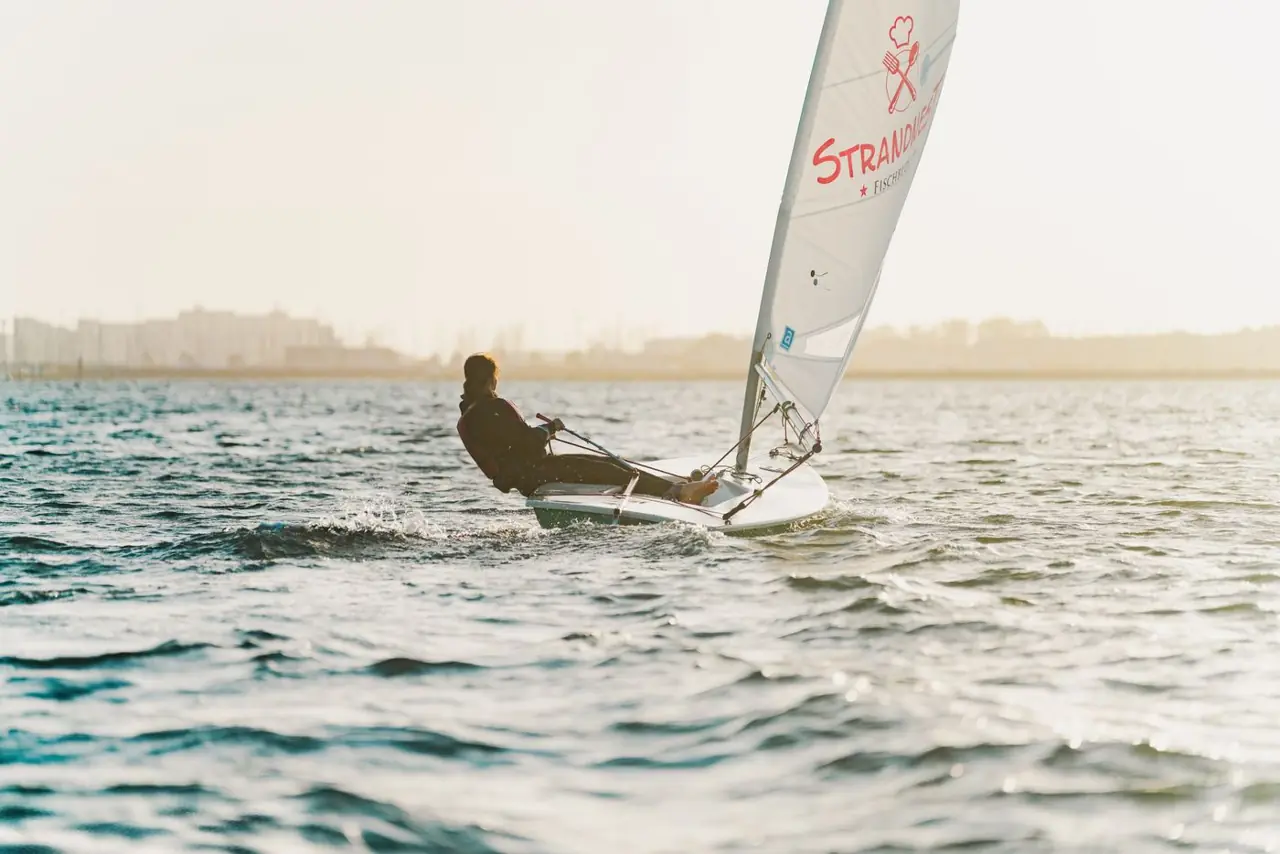
Upwind the RS100 feels like a quick, well-mannered hiking boat. Accounts of the time put its pace on a beat at about that of a standard Laser or slightly better. It planes early and accelerates in the gusts without trying to throw you in.
The interest starts at the windward mark. Bearing away, launching the pole and hoisting the kite while keeping the boat under the rig is a sequence that has to be learned, and everybody gets it wrong for a while. The class page of the day talks cheerfully about sailors comparing their “latest exhilarating ride or barrel roll” after racing. Once the sequence becomes routine, the reward is downwind speed that a hiking single-hander has no business having. The boat is credited with being as quick offwind as an RS400, which carries two people.
One quirk worth knowing: the hull floats high on its side after a capsize. If you stay on the boat, which is the usual outcome, getting it back up is easy. If you end up in the water, reaching the daggerboard takes more effort than on a lower-sided boat.
Three mainsails on one mast
| Rig | Mainsail | Notes |
|---|---|---|
| 10.2 | 10.2 m² | the big rig, for heavier sailors; rated fastest |
| 8.4 | 8.4 m² | the standard choice for mid-weight sailors |
| 7.4 | 7.4 m² | added in autumn 2010 for lightweights and the less experienced |
All three fit the standard mast. The 7.4 was announced in October 2010 with reduced roach and short battens, and the claim that a 50 kg sailor could now manage the boat. The 10.2 and 8.4 rigs have separate Portsmouth numbers, 981 and 1004 on the 2021 list.
Choosing between rigs is mostly about body weight and home waters. A light sailor on a windy estuary with the big sail will spend the afternoon swimming. A heavy sailor on a sheltered pond with the small one will spend it going slowly.
Prizes and a European Grand Prix
The RS100 collected two notable awards early: Dinghy of the Year for 2010 from Yachts and Yachting in Britain, and Sailing World’s overall Boat of the Year in the United States. The post reporting the American award quotes the magazine’s editor on how difficult the single-handed asymmetric brief is and how much detail refinement went into the boat.
Racing got organised quickly. The association’s RS100 page describes a Grand Prix series run by the international class, and the 2011 programme had four European events with the best three scores to count. It opened at Bruinisse in the Netherlands in May, moved to Gravedona on Lake Como in early July and reached Weymouth in August, where the event doubled as the UK National Championship. Charter boats were laid on for travelling sailors, and anyone who entered all four regattas together got 30 per cent off the entry fees.
Elsewhere the class was spreading by ones and twos. In April 2011 four boats formed the first RS100 fleet at a southern hemisphere event, at the Whitsunday Sailing Club’s Easter regatta in Queensland. The same month there was RS100 and RS700 racing at Pilsen in the Czech Republic. For anyone learning the boat, training and technique videos featuring Nick Peters and coach Mark Rushall appeared in late 2010.
Checks before buying a used RS100
An epoxy foam-sandwich hull is light and stiff, and it needs more care than a polyethylene one. A used RS100 is likely to have been raced, so look at it as a race boat.
- Hull skin. Press along the cockpit floor and side decks for soft patches. Look under the bow and along the keel line for trolley damage and poorly finished repairs.
- Mast. Inspect both carbon sections, especially the joint, for cracks, crushed areas or signs of a previous break.
- Spinnaker system. Run the pole out and in, check the chute mouth and sock for tears, and look along the halyard and retrieval line for chafe.
- Daggerboard and case. Chips on the trailing edge are common. A board that rattles in its case may need new packing.
- Which sails are included. A boat with only a 10.2 main is of limited use to a 70 kg sailor. Mainsails are not cheap to add.
- Fittings and ropes. Worn cleats on the kicker and downhaul make a breezy day much harder than it should be.
Neighbours in the range
The closest relative by purpose is the RS Vareo, an earlier and gentler single-hander with an asymmetric, heavier and slower but a kinder place to learn kite handling alone. Sailors who want pure hiking without a spinnaker look at the RS300, which is narrower in appeal and trickier to keep upright. Those who decide they want a wire as well as a kite go to the RS700, which is faster again and demands a good deal more practice.
Questions readers ask
How many rig sizes does the RS100 have?
Three mainsails fit the same mast: 10.2, 8.4 and, from autumn 2010, a 7.4 square metre sail aimed at lighter sailors.
Is the RS100 suitable for a beginner?
Not really. It is not a twitchy boat, but handling a kite alone while steering and hiking assumes you can already sail a single-hander confidently. It suits people with a few seasons behind them.
How fast is an RS100 compared with a Laser?
Upwind it is described as similar to, or a little quicker than, a standard Laser. Downwind with the spinnaker up it is in a different league and is said to keep pace with an RS400.
What awards did the RS100 win?
It was Yachts and Yachting's Dinghy of the Year for 2010 in the UK and Sailing World's overall Boat of the Year for 2011 in the United States.
Where it sits in the fleet
- RS Tera 2.87 m
- RS Quba 3.53 m
- RS Feva 3.66 m
- RS200 3.96 m
- RS Vareo 4.25 m
- RS300 4.27 m
- RS100 4.32 m
- RS500 4.34 m
- RS600 4.47 m
- RS600FF 4.47 m
- RS400 4.52 m
- RS Vision 4.57 m
- RS700 4.70 m
- RS800 4.80 m
- RS Elite 7.40 m
Hull length and sail area drawn to one scale, from the published figures in each class file. The shapes are schematic; a boat shown as a bare hull has no separate mainsail figure on file.
RS100 in the logbook
All International RS100 & RS500 members welcome for trg events.
The UK RS Class Association are pleased to announce a new coaching initiative for all UK and International RS Class members in 2011. RS Multi-fleet Race…
Italian Garda Cup – all invited – 24/25 April 2011
International RS Classes – RS 100, RS500, RS Feva, RS Tera. The Italians are kicking off their international season this spring, hosting the Garda Cup on the…
RS 100 Grand Prix events 2011
RS100 International Grand Prix Circuit 2011 There are four fantastic events organised for European Grand Prix Circuit in 2011. Circuit Prizes will be based on…
RS Classes – something to be proud of!
Overriding impressions of the last year – wow!! Classes with huge competitive instinct but with that desire to combine it with great fun. Proof? The RS Feva…
RS100 Boat of Year in USA – sailingworld.com
Yup, recognition for the RS100 came from Sailingworld.com in their 25th Annual Boat of the Awards. See here for the original article but here is an extract…
Message from Jimbo GBR 107 – you’ll get his drift!
Dear RS100 sailors, We thought it was about time for a quick update from RS100sailing.com. The nights have definitely drawn in and the brave few foolhardy…