RS Elite
A slender day-racing keelboat where nobody hikes and tactics decide the race.
Drag to turn the boat; pinch, or click and then scroll, to zoom. A schematic model built from published dimensions, not a builder's drawing.
| Crew | 3 |
|---|---|
| Trapeze | None |
| Designer | Phil Morrison |
| Introduced | 2004 |
| Length | 7.4 m |
| Beam | 1.72 m |
| Spinnaker | 25 m² |
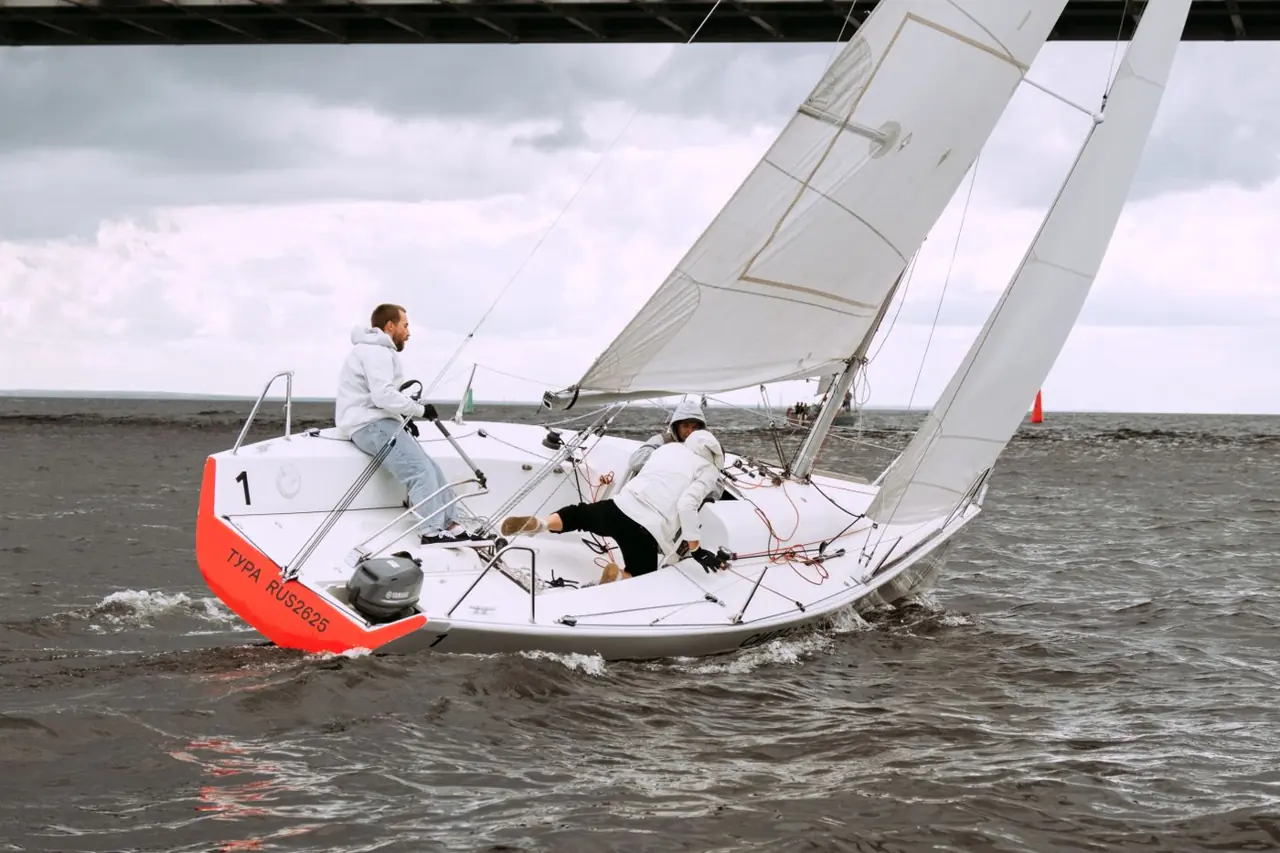
Every other boat in this section of the site capsizes. The RS Elite does not. It is a keelboat, about 7.4 metres long and only 1.72 wide, with roughly 625 kg of lead in a fin and bulb keel and a displacement of around 975 kg. Phil Morrison designed it, and it came about because a group of sailors at Hayling Island Sailing Club wanted a modern one-design to race in Chichester Harbour and Hayling Bay without the athletic demands of a dinghy.
According to the class’s own history, Morrison presented the design to club members in April 2003. Syndicates at the club ordered the first boats, a class association was formed, and the boat was launched by RS Sailing in 2004.
Long, narrow and ballasted
The proportions tell most of the story. At a length-to-beam ratio of more than four to one, the Elite is a slim boat in the tradition of classic day-racing keelboats, and it sails like one: it slips along in light airs, heels to a steady angle and then stiffens as the keel takes over.
| Length overall | about 7.4 m (24 ft) |
| Beam | 1.72 m |
| Displacement | about 975 kg |
| Ballast | about 625 kg of lead |
| Mainsail and jib | 23.5 m² |
| Spinnaker | 25 m² |
Published figures vary a little between sources, so treat the last decimal place with caution.
The comparison people make is with the Dragon. A class news writer, describing the fleet at a Caribbean resort in January 2011, put it like this: he had sailed a lot of Dragons and the Elite was “right up there in fun terms”. The same post calls it “the super popular keelboat”. Allowing for the house enthusiasm, the comparison is fair. The Elite is lighter and more modern in its rig and layout, and far simpler to own than a wooden classic.
The no-hiking rule
The class made one decision early that shaped everything else: nobody hikes. A full-length alloy bar runs down the centreline of the cockpit, the crew hook their feet under it, and their knees stay inside the boat. There is no leaning out over the rail and no premium on being young, heavy or fit.
The consequences are worth spelling out.
- Age matters less. A crew in their sixties can race level with one in their twenties.
- Crew weight matters less. Without hiking, the advantage of a heavy crew upwind in a breeze is much reduced.
- The racing is tactical. With the boats evenly matched and nobody able to buy speed with effort, positions change through starts, shifts, tide and sail trim.
- A day’s racing is less tiring. That makes three or four races in a day realistic for people who also have to go to work on Monday.
It is the opposite philosophy to the trapeze boats elsewhere in the range, and it suits a different stage of a sailing life. It appeals to former dinghy sailors whose knees have asked for a change.
Handling and crew work
The rig is a straightforward sloop with a spinnaker. The helm steers with a tiller and typically handles the mainsheet; the crew look after jib, spinnaker and the tuning controls. The boat is normally raced three-up.
Upwind in flat water the Elite is close-winded and steady, and small adjustments to rig tension and jib leads show up in the speed. Downwind it is a displacement boat most of the time, surfing in waves and breeze, and the gains come from sailing the right angles and gybing cleanly.
Because it has a keel, the venue has to suit. The Elite needs enough depth to launch and sail, and it lives on a mooring, in a boat park with a crane or slip, or on a road trailer. That is a bigger logistical commitment than a dinghy on a trolley, though the boat is light enough for a keelboat to be towed to open meetings.
Where the racing is
The class grew outwards from Hayling Island. Fleets have been recorded at:
- Hayling Island
- Cowes
- Lymington
- Royal Burnham Yacht Club
- Falmouth
- Belfast Lough
The Elite has had its own class start at Cowes Week, where 2018 brought a record entry of 21 boats. For a one-design keelboat that began with a few syndicates at one club, that is steady progress.
Buying second-hand
A used keelboat needs a different inspection from a used dinghy. Take your time, and if the sum involved is significant, consider paying a surveyor.
- Keel and keel joint. Look for cracking, weeping or rust staining where the keel meets the hull. Check the bulb for grounding damage.
- Hull below the waterline. If the boat has lived afloat, ask about antifouling history and look for blistering.
- Rudder and bearings. Check for play at the tiller and stiffness through the full arc.
- Mast, boom and standing rigging. Inspect the spars and every terminal. Ask when the wire was last replaced.
- Deck fittings and the centre bar. Check the bar is secure and that winches, cleats and tracks are firmly bedded with no sign of leaks below.
- Sails. In a tactical one-design, sail condition is the difference between racing and following. Count the seasons on each sail.
- Trailer or cradle. A roadworthy trailer adds real value. Check bearings, brakes and the supports.
- Class compliance. Ask the class association what paperwork or measurement a boat needs to race.
The Elite and the rest of the range
There is no real overlap with the dinghies. Sailors can come to the Elite from the RS400, the RS200 and from keelboat classes outside the RS family, drawn by one-design racing that does not hurt. If you want an RS boat for relaxed family sailing with no racing in view, the RS Vision is nearer the mark and far cheaper to keep. If you want the tactical racing and can still hike, the 200 and 400 fleets offer it at a fraction of the cost.
Questions readers ask
Is the RS Elite a dinghy?
No. It is a keelboat of about 7.4 metres with a lead-ballasted fin and bulb keel, displacing a little under a tonne. It is the odd one out in a range otherwise made up of dinghies and skiffs.
Do you have to hike on an RS Elite?
No. Class racing has a no-hiking rule: the crew keep their knees inside the boat and hook their feet under a full-length alloy bar on the centreline. Races are decided by trim and tactics, not by fitness on the rail.
Where are RS Elites raced?
The class began at Hayling Island. Fleets have been listed at Hayling, Cowes, Lymington, Royal Burnham Yacht Club, Falmouth and Belfast Lough, and the class has had its own start at Cowes Week.
Who designed the RS Elite?
Phil Morrison, designer of the RS200, RS400, RS500 and RS800. His original presentation of the design to Hayling Island Sailing Club members is dated April 2003.
Where it sits in the fleet
- RS Tera 2.87 m
- RS Quba 3.53 m
- RS Feva 3.66 m
- RS200 3.96 m
- RS Vareo 4.25 m
- RS300 4.27 m
- RS100 4.32 m
- RS500 4.34 m
- RS600 4.47 m
- RS600FF 4.47 m
- RS400 4.52 m
- RS Vision 4.57 m
- RS700 4.70 m
- RS800 4.80 m
- RS Elite 7.40 m
Hull length and sail area drawn to one scale, from the published figures in each class file. The shapes are schematic; a boat shown as a bare hull has no separate mainsail figure on file.