RS300
A light, tippy, single-sail hiking boat that repays every hour of practice.
Drag to turn the boat; pinch, or click and then scroll, to zoom. A schematic model built from published dimensions, not a builder's drawing.
| Crew | 1 |
|---|---|
| Trapeze | None |
| Designer | Clive Everest |
| Introduced | 1998 |
| Length | 4.27 m |
| Beam | 2.01 m |
| Hull weight | 58 kg |
| Mainsail | 9.9 m² |
| Portsmouth number | 972 (2018) |
Most single-handed dinghies are designed to be accessible first and fast second. The RS300 reversed the order. Clive Everest, who had made his name designing International Moths, drew a hiking single-hander that borrowed the Moth’s thinking: very little hull in the water, low weight, wide flared decks to hike from. It went into production in 1998, won Small Sailing Boat of the Year at the British Nautical Awards that year, and in 2000 was put on show in the Millennium Dome as a “Millennium Project”.
It has never been a mass-market boat. People who sail one tend to be very attached to it.
A boat that will not stand up on its own
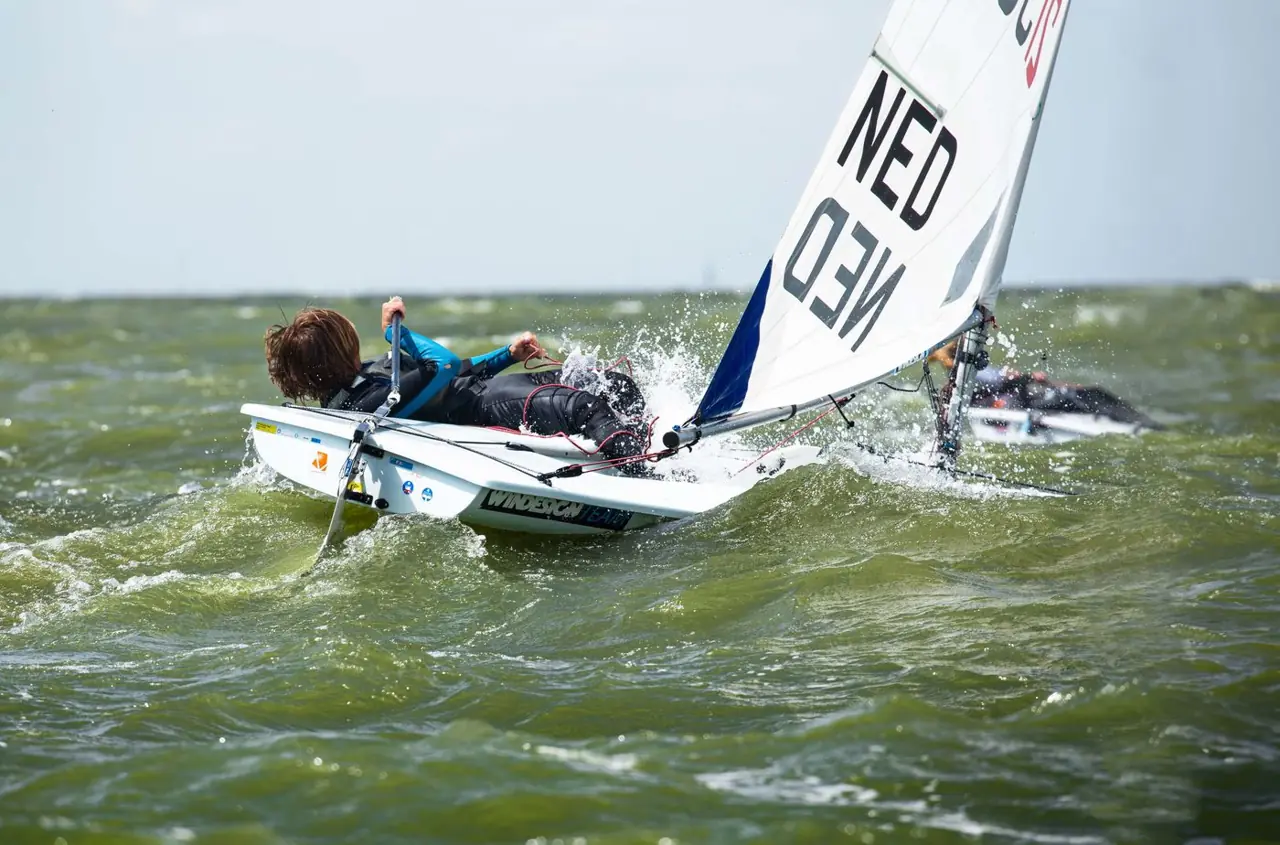
Step into an RS300 at the pontoon as you would into a Laser and you will probably be swimming before the sail has filled. The hull is narrow on the waterline and gives almost no form stability. The beam of about two metres is all flare, there to give the sailor leverage, and it does nothing to steady the boat at rest.
So the RS300 has to be balanced, constantly, with body weight and sheet. Tacks need commitment: move too late and the boat falls in on top of you, too early and it goes the other way. Gybes in a breeze are a matter of timing and nerve. Bearing away round the windward mark with the boom out and the bow down is the manoeuvre that catches most people in their first season.
What you get in return is a boat that feels alive in a way heavier single-handers do not. It accelerates in the smallest puff, planes readily with a fit sailor on the side, and carves through manoeuvres when you get them right. Steve Cockerill, a national champion in the class and in several others, wrote in Yachts and Yachting in 2000 that it was among the most challenging and exciting dinghies he had sailed, and the first that was a joy simply to sail round the course.
Rig A and Rig B
There are two sails.
- Rig A: about 9.2 m², the smaller sail.
- Rig B: about 9.9 m², the larger.
The reasoning is straightforward. A hiking boat with one sail size favours whoever happens to be the ideal weight. Two sizes let a lighter sailor and a heavier one race with similar power for their weight and similar handling. The hull is epoxy GRP foam sandwich at around 58 kg, with an all-up sailing weight quoted at about 75 kg, so the sailor is by far the heaviest thing on board and small differences in body weight show.
The class Portsmouth number was 972 on the 2018 list. For comparison, that is the same figure the two-person trapeze RS500 carried in 2011, and quicker than the RS100 with its spinnaker. For a boat with one sail and no wire, that is fast.
Who actually sails them
The RS300 suits a particular kind of sailor: someone with solid single-handed experience, reasonable fitness and the patience to be bad at something for a while. Ex-Laser and ex-Solo sailors looking for more sensation come to it. So do people who fancied a Moth but wanted a boat that could be launched off a normal slipway and raced in a normal club fleet.
It is a poor choice as a first single-hander and an uncomfortable one for anyone who dislikes capsizing. It works best at clubs with a few of them, where newcomers can copy what the quick people do with their feet and hands in a tack.
The RS300 raced as a British class, outside the four international classes whose 2010 and 2011 news fills this logbook, so you will find no RS300 race reports here.
Where it sits among the single-handers
| Boat | Sails | Wire | Character |
|---|---|---|---|
| RS Vareo | main + asymmetric | no | forgiving, a way to learn kite handling |
| RS100 | main + asymmetric | no | modern, quick downwind, stable enough |
| RS300 | main only | no | light and tippy, quick upwind and down |
| RS600 | main only | yes | trapeze and racks, faster and harder again |
| RS700 | main + asymmetric | yes | the full single-handed skiff |
The RS600 is the 300’s closest relation in spirit, and Everest co-designed that boat too. If the RS300 is a hiking Moth-cousin, the RS600 is the same idea with a trapeze attached.
Inspecting a second-hand RS300
Numbers built are modest and the boats are raced hard, so a careful look is worth the time.
- Hull laminate. Foam sandwich is light and stiff when sound. Press the side decks where the sailor’s weight lands, the cockpit floor and the area around the daggerboard case. Any softness, creaking or visible cracking suggests the skin has separated from the core.
- Gunwales and wing edges. These take the knocks when the boat comes alongside or is righted. Look for chips and rough repairs.
- Mast and boom. Check the full length for cracks or kinks, and the mast step and deck collar for wear.
- Which rig. Establish whether the boat comes with Rig A, Rig B or both, and whether that matches your weight.
- Daggerboard and rudder. Damaged tips and trailing edges slow the boat. Check the rudder stock for play, since this boat is steered with fingertips.
- Water inside. Weigh it if you can, or at least pull the bungs after a sail. A light boat that has taken on water in the laminate is no longer a light boat.
Budget for a decent sail if the one supplied is tired. In a class this sensitive, a stretched sail and a heavy hull take away much of what makes the boat worth having.
Questions readers ask
Why is the RS300 considered difficult?
The design is inspired by the International Moth, with a light hull that offers little stability of its own. It has to be balanced actively all the time, including when stationary. Most newcomers capsize a lot in the first few outings.
What are Rig A and Rig B?
Two sail sizes for the same boat, about 9.2 and 9.9 square metres. Rig A is the smaller. The intention is that lighter and heavier sailors end up with a similar power-to-weight ratio.
Does the RS300 have a spinnaker or trapeze?
Neither. It is one sail, a daggerboard and a hiking sailor. The speed comes from low weight and a narrow, easily driven hull.
Who designed the RS300?
Clive Everest, a successful International Moth designer. The boat first went into production in 1998.
Where it sits in the fleet
- RS Tera 2.87 m
- RS Quba 3.53 m
- RS Feva 3.66 m
- RS200 3.96 m
- RS Vareo 4.25 m
- RS300 4.27 m
- RS100 4.32 m
- RS500 4.34 m
- RS600 4.47 m
- RS600FF 4.47 m
- RS400 4.52 m
- RS Vision 4.57 m
- RS700 4.70 m
- RS800 4.80 m
- RS Elite 7.40 m
Hull length and sail area drawn to one scale, from the published figures in each class file. The shapes are schematic; a boat shown as a bare hull has no separate mainsail figure on file.