RS600
One sail, one wire, a pair of racks and a famously steep first season.
Drag to turn the boat; pinch, or click and then scroll, to zoom. A schematic model built from published dimensions, not a builder's drawing.
| Crew | 1 |
|---|---|
| Trapeze | Helm |
| Designer | Clive Everest & Nick Peters |
| Length | 4.47 m |
| Beam | 1.93 m |
| Hull weight | 52 kg |
| Mainsail | 12.2 m² |
| Portsmouth number | 916 (2012) |
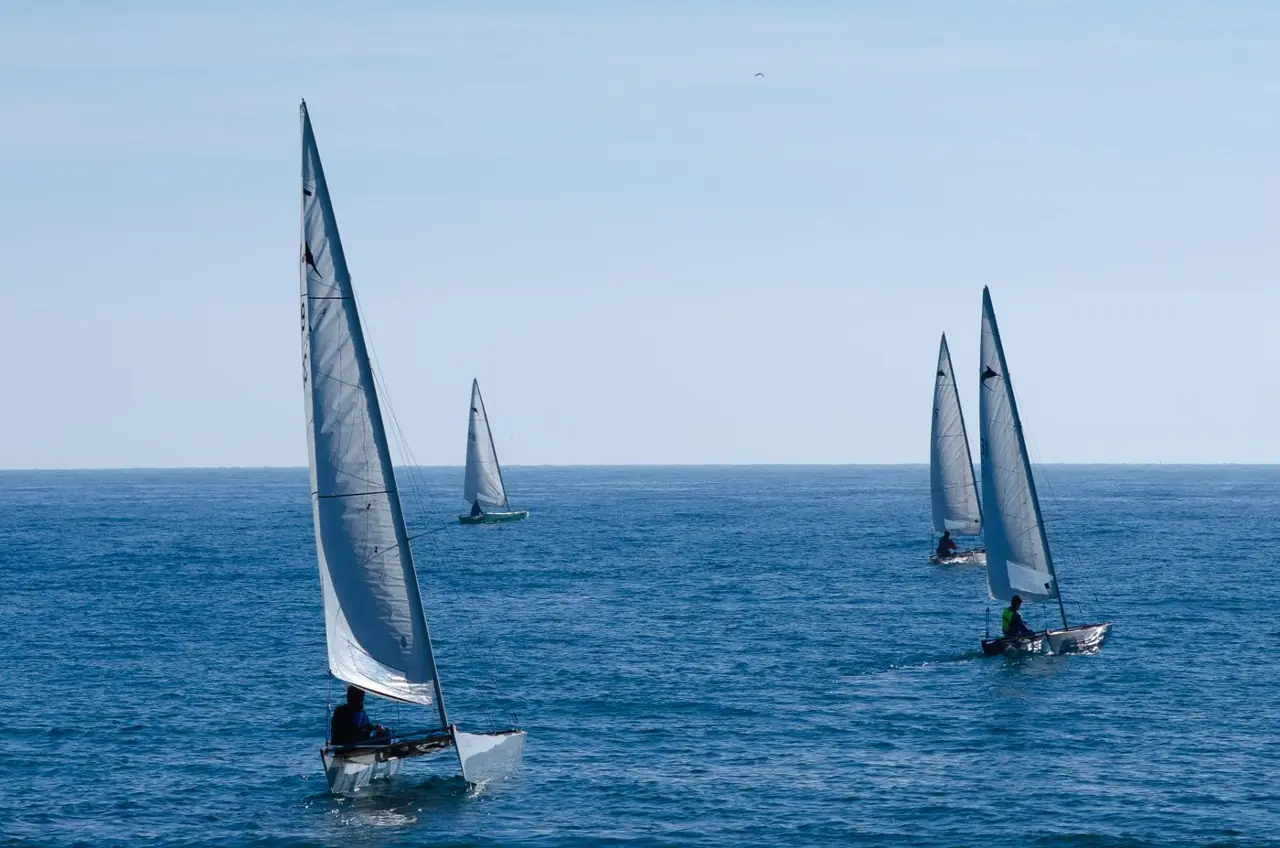
The RS600 has one sail and one trapeze wire per side, and very little to stand on. Clive Everest and Nick Peters designed it as a single-handed trapeze boat with racks: a light epoxy hull under a tall rotating carbon mast and a fully battened Mylar mainsail of about 12 square metres. There is no jib and no spinnaker. The helm steers from the wire with a long tiller extension in one hand and the mainsheet in the other, and when it goes well it is about as direct a sailing experience as a dinghy can offer.
It was supplied by RS Sailing and later built by the Boatyard at Beer.
Anatomy of the boat
| Length | 4.47 m |
| Beam, racks in | 1.93 m |
| Beam, racks extended | 2.13 m |
| Hull weight | about 52 kg |
| Sailing weight | about 76 kg |
| Mainsail | about 12.2 m² |
| Mast | carbon, stayed, rotating; aluminium boom |
| Foils | daggerboard |
| Portsmouth number | 916 (2012) |
Two details set the RS600 apart from other trapeze single-handers.
The racks. Aluminium racks run down each side and come in two sizes, chosen by the helm’s weight. A lighter sailor uses the wider setting to gain leverage, so a range of body weights can race on something like level terms.
The reefing rig. The mainsail has a reef that zips in, and the mast has a removable bottom section. Take the section out and zip the reef, and you have a shorter mast carrying a smaller sail, a proper heavy-weather rig that still sets cleanly. For a boat this lively, being able to reduce sail properly makes the difference between going sailing on a windy day and staying in the dinghy park.
Learning to sail it
Nobody steps into an RS600 and sails away tidily. The hull is narrow and has little stability at rest, so even getting from the slipway to open water involves balance. Once moving, you have to get out on the wire smoothly while steering and sheeting, then come back in and cross the boat through a tack without stopping it dead.
A typical progression:
- Reaching back and forth on the wire in a moderate breeze, falling in at each end.
- Tacks that work more often than they fail.
- Bearing away in a breeze without pitching in, which means weight well back and no hesitation.
- Gybes, which come last and stay unreliable longest.
A few practical points help. Learn on flat water. Use the reefed rig early on without embarrassment. Wear a helmet if the boom worries you. And sail in company, because a capsized 600 with a tired helm benefits from someone standing by.
The compensation for all this is speed and feel. With one sail there is nothing to distract from trim and steering, and the boat planes upwind and down as soon as there is enough breeze to trapeze. On a reach in flat water it is very fast, and it does it quietly.
Racing and handicap
The RS600 raced as a one-design fleet within the RS circuit, and it was on the bill for the multi-class RS Eurocup at Carnac in May 2011. The international news of those years otherwise concentrated on the Tera, Feva, RS100 and RS500, so there are no RS600 results in this logbook.
On handicap its RYA number was 916 on the 2012 list. That put it well clear of the hiking single-handers, the RS300 included, and behind only the spinnaker-carrying RS700 among the range’s single-handed boats.
Fleet racing today depends heavily on location. Many RS600s now sail in club handicap fleets. Check what is sailed locally before buying if class racing matters to you.
RS600, RS700 or foils?
The RS700 arrived in 2001 and Nick Peters, again one of its designers, described it as conceptually very different. It adds an asymmetric spinnaker and adjustable-width wings and is longer, and it gives the helm more to do downwind. The 600 is the purer and twitchier boat.
The other branch is the RS600FF, the hydrofoiling version that became available in 2007. It uses the same hull with a rudder gantry, different foils and a wand at the bow. Most were converted from standard boats, so some 600s on the second-hand market may have had a foiling life.
For sailors who want the trapeze-free version of the same designer’s thinking, the RS300 is the hiking equivalent: similar length, smaller sail, the same need for balance.
Second-hand checks
The newest RS600s are not new, and all of them have been capsized many times. Go through the boat methodically.
- Racks and their sockets. Look for bent tubes, cracked welds and wear where the racks plug into the hull. Check which size of rack is fitted.
- Mast. Inspect the carbon along its length, at the joint for the removable bottom section and at the spreader and hounds fittings. Make sure the bottom section is included.
- Mast step and rotation. The mast should rotate freely with no slop at the heel.
- Hull. Epoxy foam sandwich is light and can be dented. Press the foredeck, the cockpit floor and the gunwale area under the racks.
- Sail. Mylar delaminates with age and sun. Check the zip for the reef works along its whole length.
- Trapeze wires and shrouds. Replace on age alone if there is no record of when they were last changed.
- Evidence of an FF conversion. A gantry mounting on the transom or a modified daggerboard case tells you the boat has been foiled. Not a fault, but ask what was done and how it was put back.
Spares for older, lower-volume classes can take some finding, so a boat that comes with spare foils, a second sail or a spare mast section is worth more than its asking price suggests.
Questions readers ask
Is the RS600 hard to sail?
Yes, by common consent. It is a narrow, light hull with a large sail, sailed from a trapeze by one person who is also steering. Expect a lot of swimming while learning, and choose flat water and moderate wind for the first outings.
Can the RS600 be reefed?
Yes. The mainsail has a zip-in reef and the carbon mast has a removable bottom section, so the whole rig is shortened when the sail is reefed.
Does the RS600 have a spinnaker?
No. It carries a single fully battened Mylar mainsail. The single-handed trapeze boat with an asymmetric spinnaker is the RS700.
What is the RS600FF?
A hydrofoiling version, available from 2007, using the standard RS600 hull with a rudder gantry, different foils and a bow wand. Many were converted from existing RS600s.
Where it sits in the fleet
- RS Tera 2.87 m
- RS Quba 3.53 m
- RS Feva 3.66 m
- RS200 3.96 m
- RS Vareo 4.25 m
- RS300 4.27 m
- RS100 4.32 m
- RS500 4.34 m
- RS600 4.47 m
- RS600FF 4.47 m
- RS400 4.52 m
- RS Vision 4.57 m
- RS700 4.70 m
- RS800 4.80 m
- RS Elite 7.40 m
Hull length and sail area drawn to one scale, from the published figures in each class file. The shapes are schematic; a boat shown as a bare hull has no separate mainsail figure on file.