RS Vareo
A steady GRP single-hander for learning to fly an asymmetric kite on your own.
Drag to turn the boat; pinch, or click and then scroll, to zoom. A schematic model built from published dimensions, not a builder's drawing.
| Crew | 1 |
|---|---|
| Trapeze | None |
| Designer | Phil Morrison |
| Introduced | 2001 |
| Length | 4.25 m |
| Beam | 1.57 m |
| Hull weight | 70 kg |
| Mainsail | 8.7 m² |
| Spinnaker | 9.9 m² |
| Portsmouth number | 1085 |
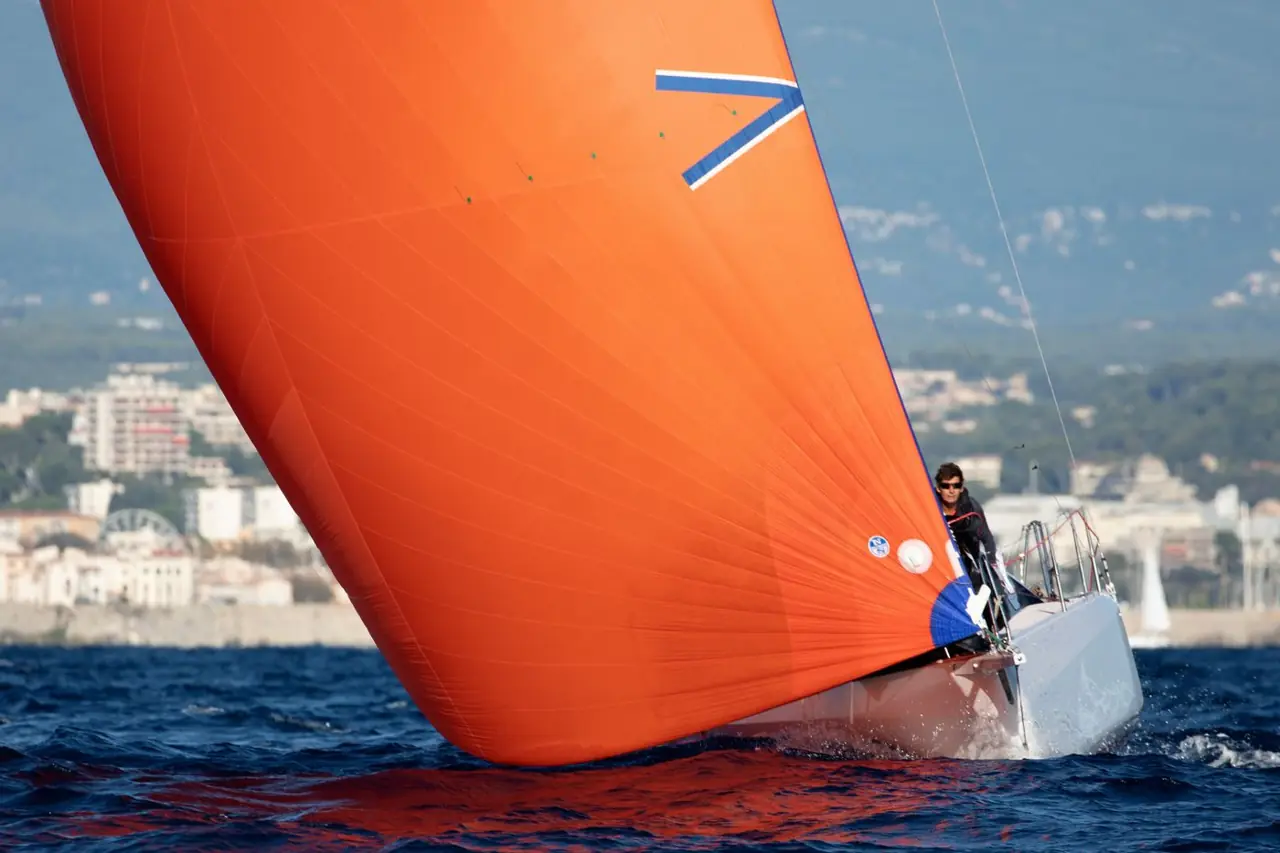
Eight years before the RS100 arrived, there was the RS Vareo. Phil Morrison designed it and it appeared in 2001: a 4.25 metre hiking single-hander in polyester GRP with a Coremat core, carrying a mainsail and an asymmetric spinnaker of about 10 square metres. No trapeze, no racks, no jib. It was meant to give an ordinary club sailor the experience of flying a kite alone without requiring the reflexes of a skiff sailor, and that is still its appeal on the second-hand market.
Friendly, on purpose
The Vareo is not a light boat. The hull is about 70 kg and the all-up sailing weight is given as about 93 kg, noticeably more than the epoxy single-handers elsewhere in the range. On the water that weight shows as steadiness. The boat carries its way through tacks, does not skitter about in gusts and gives a newcomer time to think.
Upwind it is a conventional hiking dinghy. You sit out, play the mainsheet and steer through the waves, and anyone who has sailed a Laser or a Solo will feel at home within minutes. The cockpit is roomier than either.
The spinnaker changes the afternoon. Hoisting and lowering are done from the cockpit, and once the kite is drawing the boat picks up and planes on a broad reach. You then have three things in two hands: tiller, mainsheet and spinnaker sheet. The usual answer is to set the main, more or less forget it, and sail on the spinnaker sheet and the tiller. Gybing means letting the kite blow round the forestay and picking up the new sheet as you cross. The first few attempts are untidy. It comes together with practice, and the Vareo’s stability means most of the mistakes end in a flapping sail and no swim.
Two mainsails
The boat was offered with a choice of main:
| Sail | Approx. area | Purpose |
|---|---|---|
| Fun sail | 7.9 m² | general sailing and learning |
| Competition sail | 8.7 m² | racing |
The spinnaker area is given as about 9.9 square metres. Sources do not agree perfectly on Vareo sail areas, and catalogues from different years list different figures, so check the actual sails on any boat you look at.
Portsmouth numbers are similarly reported differently in different places. The figure most often quoted is 1085, which rates the boat slightly quicker than a Laser. Use the current RYA list for club racing.
The racing years
The Vareo was raced across the UK at club and national level. National Championships gave the fleet its main date of the season.
The international class news of 2010 and 2011 was all Tera, Feva, RS100 and RS500, with no Vareo reports. By then the newer, lighter RS100 had been launched.
In handicap racing a Vareo can be good value on courses with long reaches and frustrating on windward-leeward courses in light air, where carrying a spinnaker gains little.
Who should look at one
- Club sailors curious about asymmetrics. If you have only sailed single-sail boats and want to learn kite handling without a crew to shout at, this is a gentle classroom.
- Heavier single-handers. The boat carries weight better than small, light hulls.
- People who sail for pleasure and race occasionally. With the kite up on a breezy reach it is fun regardless of whether anything else is on the water to race against.
- Sailors planning a later move to something quicker. Skills learned in the Vareo apply directly to the RS100.
If you want tight class racing every weekend, check first what is sailed near you.
Vareo or RS100?
The two boats do the same job a decade apart.
| RS Vareo | RS100 | |
|---|---|---|
| Launched | 2001 | 2009 |
| Designer | Phil Morrison | Paul Handley |
| Hull | polyester GRP with Coremat | epoxy foam sandwich |
| Hull weight | about 70 kg | about 52 kg |
| Spinnaker | about 9.9 m² | about 12.1 m² |
| Portsmouth number | 1085 | 981 to 1004 by rig (2021) |
The RS100 is lighter, has a carbon mast and a bigger kite, and rates around eighty to a hundred points faster. It is the sharper racing boat. The Vareo is the calmer one. For a sailor who simply wants to find out whether single-handed spinnaker sailing appeals, the older boat is likely to answer the question for less money.
If a spinnaker does not appeal at all and the aim is a demanding single-sail boat, the RS300 lies in the other direction. For two-handed asymmetric sailing in a boat of similar length and the same designer, see the RS200.
Inspecting a used Vareo
Most Vareos are now well into their second decade. A sound one will give years of service; a neglected one can soak up money.
- Hull stiffness and weight. Coremat laminates can soften and absorb water with age. Press the cockpit floor and the side decks, and if the boat feels heavy on the trolley, be suspicious.
- Mast step and deck around the mast. Look for stress cracks radiating from fittings.
- Spinnaker chute, pole and sock. Run the hoist and drop on land. A system that jams ashore will jam worse afloat with one pair of hands.
- Daggerboard and case. Check the board’s edges and the fit in the case.
- Rudder stock and blade. Look for play and for damage to the tip.
- Sails. Establish which mainsail is included and how old it and the spinnaker are. Replacement sails for a discontinued class may need ordering from a sailmaker.
- Spars. Sight along the mast and boom for bends and check fittings for corrosion.
- Spares availability. Before buying, ask a dealer or the class which class-specific parts can still be had.
Bought carefully, a Vareo is one of the cheapest ways to sail with a spinnaker on your own.
Questions readers ask
Is the RS Vareo easy to sail?
As single-handers with spinnakers go, yes. It is a stable hiking boat and can be sailed with the mainsail alone until you are ready for the kite. Handling the spinnaker solo still takes practice.
How does the Vareo compare with a Laser?
With a Portsmouth number given as 1085 it rates a little faster than a Laser on the RYA scheme. It is a heavier, roomier boat and the speed difference comes mainly from the spinnaker offwind.
Is the RS Vareo still made?
Specification databases list it as produced from 2001 and now discontinued. Used boats are the realistic route into one.
Can two people sail a Vareo?
It is designed and raced as a single-hander. The cockpit has room for a passenger on a gentle day, but that is not what the boat is for.
Where it sits in the fleet
- RS Tera 2.87 m
- RS Quba 3.53 m
- RS Feva 3.66 m
- RS200 3.96 m
- RS Vareo 4.25 m
- RS300 4.27 m
- RS100 4.32 m
- RS500 4.34 m
- RS600 4.47 m
- RS600FF 4.47 m
- RS400 4.52 m
- RS Vision 4.57 m
- RS700 4.70 m
- RS800 4.80 m
- RS Elite 7.40 m
Hull length and sail area drawn to one scale, from the published figures in each class file. The shapes are schematic; a boat shown as a bare hull has no separate mainsail figure on file.