RS400
A big-kite hiking boat for two adults, with a bowsprit that swings to windward.
Drag to turn the boat; pinch, or click and then scroll, to zoom. A schematic model built from published dimensions, not a builder's drawing.
| Crew | 2 |
|---|---|
| Trapeze | None |
| Designer | Phil Morrison |
| Length | 4.52 m |
| Beam | 1.98 m |
| Hull weight | 85 kg |
| Spinnaker | 13.9 m² |
| Portsmouth number | 948 (2012) |
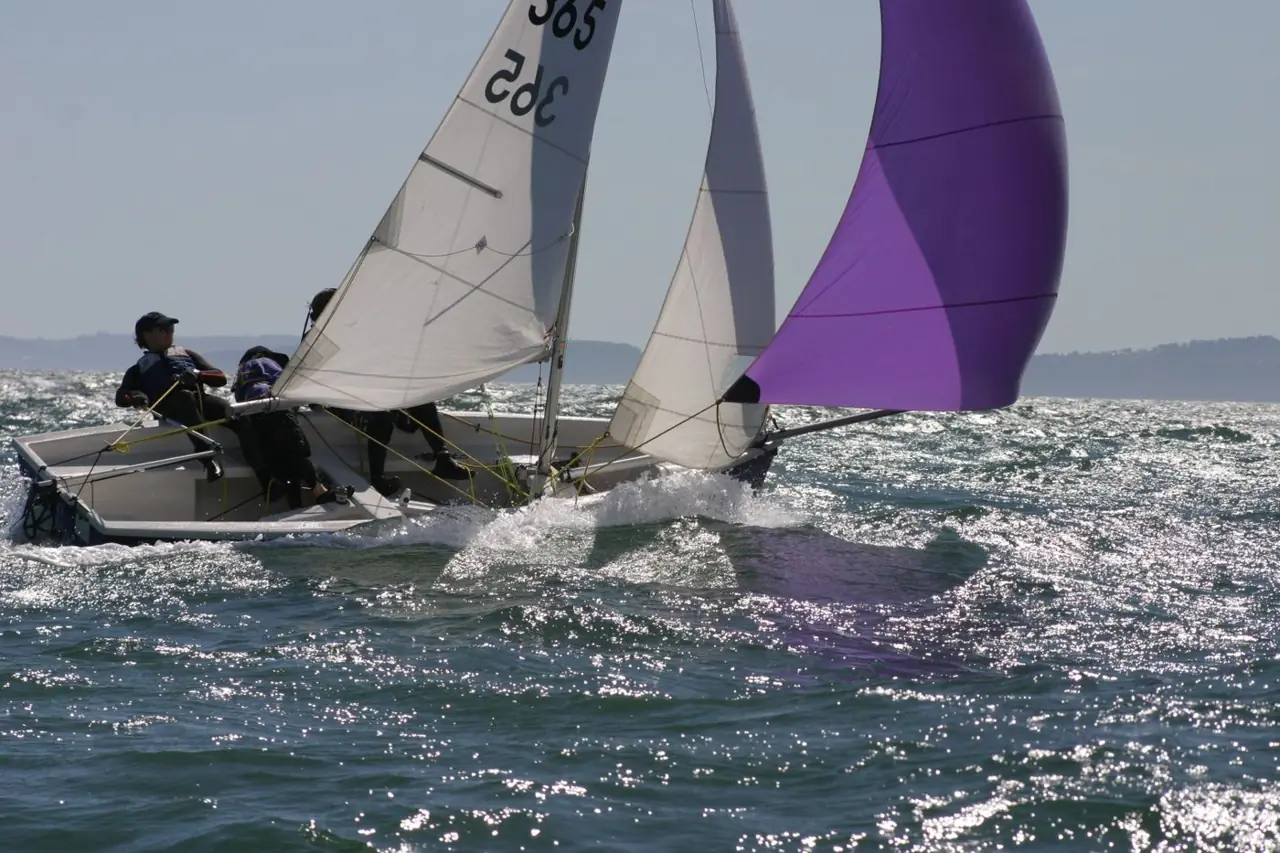
The RS400 is the big hiking two-hander of the RS range. Phil Morrison designed it for two adults who want asymmetric-spinnaker speed without going out on a wire: 4.52 metres long, nearly two metres wide, with fully battened main and jib and a spinnaker of roughly 14 square metres set from a retractable bowsprit. It has been raced at British clubs for a long time, and plenty of the hulls are as old as their crews’ children.
In the international class news of 2010 and 2011 the RS400 turns up as one of the family more than as a star turn. It was on the bill at the multi-class RS Eurocup at Carnac in May 2011, racing on the Baie de Quiberon alongside the 200, 500, 600, 700 and 800 fleets.
Layout and rig controls
Morrison kept the inside of the boat simple. The main control lines are led to both sides, so either the helm or the crew can reach them from the hiking position. In practice crews divide the jobs to suit themselves, and the split varies from boat to boat.
The rig gives a keen crew a lot to adjust:
- Mast bend is set with a screw at deck level and with adjustable spreaders.
- Rake and sideways bend can be altered further through the jib halyard tension.
- Both sails are fully battened, so they hold their shape and respond clearly to changes in bend.
- The bowsprit extends and retracts, and can also be swung to windward.
That last feature is the RS400’s signature. On most asymmetric dinghies the pole points straight ahead, and the only way to go deeper downwind is to accept a collapsing kite. On the 400 the crew can pull the pole end across to windward. The spinnaker rotates round from behind the mainsail and the boat can run lower and still keep it filled. In light and moderate winds, when planing angles do not pay, working the pole is one of the main ways of gaining ground on a run.
The spars are aluminium alloy and the hull is polyester GRP foam sandwich, weighing about 85 kg.
What it is like
Powerful is the word people reach for. Upwind in a breeze the RS400 needs both of you over the side, flat out, and it rewards weight and fitness. The sail plan is generous at about 14.8 square metres of main and jib, and a light crew will be easing sheets while a heavier pair is still driving.
Turn the corner and hoist, and the boat picks up and goes. The kite is big for a hiking dinghy and the loads are real, so the crew needs to be capable and the helm needs to steer for the spinnaker instead of pointing at the mark. In waves it is fast and wet. On flat water in a breeze, gybing through a crowded leeward gate with fifteen other 400s is as tense as dinghy racing gets without a trapeze harness.
It is also a roomy, stable boat by performance standards. Two normal-sized adults can sail it without contortion, and it does not punish small errors with an instant swim. That combination of speed and manners is why it has lasted.
The crews it suits
The RS400 was designed for a wide weight range and it draws its regulars from a few recognisable groups: adult pairs who have outgrown lighter boats, former trapeze sailors who still want pace, and helms from traditional symmetric-kite classes who fancy an asymmetric without changing how they sit in a boat.
It is less suitable for a small crew on open water. If the two of you are light, the RS200 is the same idea at a size you can hold down.
Against its siblings
| RS200 | RS400 | RS500 | |
|---|---|---|---|
| Length | 3.96 m | 4.52 m | 4.34 m |
| Righting power | both hike | both hike | crew on trapeze |
| Spinnaker | about 8.3 m² | about 13.9 m² | about 13.5 m² |
| Portsmouth number | 1046 (2015) | 948 (2012) | 972 (2011) |
The handicap column is the surprising one. The RS400, with no wire, was rated quicker than the trapeze RS500 in the lists of that period. The 500 is narrower, lighter in feel and suits lighter, younger crews; the 400 does it with beam, sail area and two people’s worth of hiking.
The single-handed RS100 is sometimes mentioned in the same breath, because offwind it is credited with roughly matching the 400’s pace. For crews who want to go faster still and are happy for both sailors to trapeze, the next step is the RS800.
Looking at a used RS400
There are many about, across a wide spread of ages. The usual points:
- Foam-sandwich hull. Check for soft areas in the cockpit floor and on the side decks, and for cracks around the thwart and centreboard case. Older boats that have been stored wet can gain weight.
- Bowsprit mechanism. Extend, retract and swing the pole. Look at the bow fitting and the pivot arrangement for wear, and at the launch line for chafe.
- Mast, spreaders and deck-level bend control. Make sure the adjusters move freely and nothing is corroded solid. Sight up the mast for permanent bend.
- Centreboard and gasket. Operate the board through its full travel and inspect the slot gasket.
- Sails. Fully battened sails last reasonably well, but check batten pockets and the leech. Ask the age of the spinnaker in particular.
- Rudder. Check the stock, pintles and downhaul for play.
- Combi trailer. For a boat of this size a sound road base and trolley is a significant part of the value.
A structurally sound older boat is a cheap way into a quick class. Spend the saved money on a spinnaker and some new rope.
Questions readers ask
What makes the RS400's bowsprit unusual?
It can be angled to windward as well as extended. Swinging the pole across lets the spinnaker rotate out from behind the mainsail, so the boat can sail deeper downwind angles than a fixed centreline pole allows.
Is the RS400 good for heavier crews?
It is designed for a wide crew weight range and is generally the better pick for larger adult pairs, who would be cramped and slow in an RS200.
Does the RS400 have a trapeze?
No. Both sailors hike. It is among the faster hiking two-handers on the handicap lists without using wires or racks.
How fast is an RS400 on handicap?
Its RYA Portsmouth number was 948 on the 2012 list, which is about a hundred points quicker than the RS200 and a little quicker than the trapeze RS500 of the same period.
Where it sits in the fleet
- RS Tera 2.87 m
- RS Quba 3.53 m
- RS Feva 3.66 m
- RS200 3.96 m
- RS Vareo 4.25 m
- RS300 4.27 m
- RS100 4.32 m
- RS500 4.34 m
- RS600 4.47 m
- RS600FF 4.47 m
- RS400 4.52 m
- RS Vision 4.57 m
- RS700 4.70 m
- RS800 4.80 m
- RS Elite 7.40 m
Hull length and sail area drawn to one scale, from the published figures in each class file. The shapes are schematic; a boat shown as a bare hull has no separate mainsail figure on file.